
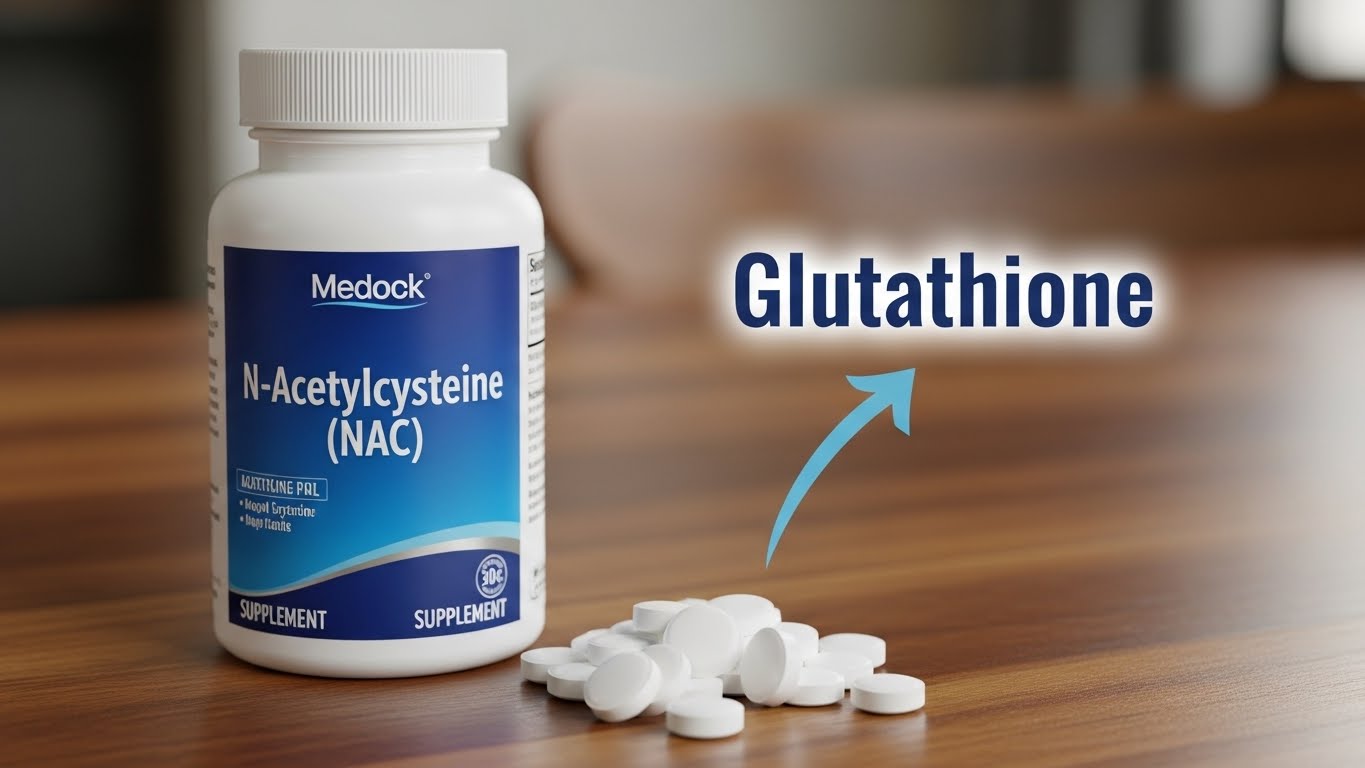
Highlights
- N-Acetyl cysteine (NAC) is a molecule that donates one of the essential amino acids cysteine is one of the key ingredients in many drugs that break up mucus (mucolytic) in chronic respiratory diseases
- NAC also provides the amino acid cysteine which is the key precursor for making Glutathione in the body and is commonly taken as a supplement for boosting Glutathione levels
- Clinical trials have shown that 2400 to 2700 mg/day of NAC boosts glutathione levels in the blood and brain
- Oral NAC supplementation has been found to be safe and well tolerated at a range of doses with the main adverse effects being various gastrointestinal issues (see below)
The Biology
Glutathione is a tripeptide made from glutamate, cysteine and glycine. It is the principal antioxidant in our blood. With age however our glutathione level decreases significantly, leading to higher risk of cell and tissue damage from oxidation. In most cases, the amino acid Cysteine is the rate-limiting precursor for glutathione synthesis. In a few cases the 2nd limiting amino acid is glycine (But more on that later). N-acetylcysteine (NAC) is a cysteine donor and is widely used as a supplement to provide cysteine as a precursor for glutathione synthesis. In addition to being a glutathione precursor, NAC can directly scavenge reactive oxygen species, which are byproducts of metabolic processes and can cause oxidative damage, and other harmful oxidants from the blood. NAC is also used clinically to break up mucus (mucolytic). It is an active agent is drugs like Mucomyst™ and Pulmozyme™. In addition to its redox function, NAC reduces pro-inflammatory cytokines such as IL-8 and TNF alpha it also has vasodilatory effects via it’s thiol group.
Clinical Evidence
The most well validated effect of NAC is its use an antidote for acetaminophen (aka paracetamol) overdose, administered within ~8 hours of the overdose event. It is also used in mucolytic drugs to alleviate symptoms of bronchitis and other related chronic respiratory ailments. While the strongest clinical evidence for NAC benefit is in respiratory and acetaminophen toxicity reversal, there are other indications in which NAC has shown clinical benefits (e.g. improving coronary and peripheral blood vessel function), although the level of evidence is not as strong. Here is a subset of clinical trials using NAC with a particular focus on glutathione levels:
Oral NAC increases brain glutathione in patients with psychiatric disorders:
- In a study on 40 patients with schizophrenia, 2400 mg/day of NAC was given for 8 weeks. The study found that glutathione level in the brain’s medial prefrontal cortex increased. The study did not find any cognitive improvements. The increase in brain glutathione correlated with a higher ratio of reduced/oxidized glutathione in plasma.
- In another randomized double-blind trial on early psychosis patients, 63 patients were either given placebo or 2700 mg/day of NAC for 6 months. NAC treatment led to improvement in neurocognition (processing speed). And levels of glutathione in the brain (23%) and blood cells (19%) increased.
Oral NAC increases blood glutathione:
- 60 patients with substance use disorders who were on methadone treatment, were randomized to either placebo or 2400 mg/day of NAC for 12 weeks. In this study NAC treatment elevated blood glutathione levels and antioxidant capacity. There was also a reduction in the inflammation marker high-sensitivity C-reactive protein (hs-CRP) and insulin resistant measure HOMA-IR showing an overall inflammation and metabolic health improvement.
- In a small non-randomized clinical trial, 17 carriers of a rare disease called cystatin C amyloid angiopathy were treated with 2400 mg/day of NAC for 9 months. Reduced glutathione (GSH) levels in their plasma were significantly increased.
Safety
Oral NAC has a long history of safety. In chronic respiratory diseases such as COPD and cystic fibrosis where NAC is used as a mucolytic agent, 600mg/day is the maximum licensed dose. However, upto 3000 mg/day has been tested (1000 mg x 3 for 4 weeks) and found to be safe and well tolerated. Many trials on chronic respiratory disease patients such as COPD and IPF have tested 1200 mg to 1800 mg (600 mg x 2 or 3 for as long as 60 weeks). The most common adverse effects reported have been gastrointestinal such as abdominal pain, gastritis, nausea etc. In general, no difference in tolerability was reported at the standard vs. high doses.
Supplementation
Clinical trials for boosting glutathione levels have used 2400 to 2700 mg oral NAC per day. However, in chronic respiratory diseases where NAC is used as mucolytic agent, 600 mg/day is the licensed dose. Many trials, however, have used 1200 or 1800 mg/day orally for as long as 60 months.
Rani, M., Aggarwal, R., & Vohra, K. (2020, September). Effect of N-acetylcysteine on metabolic profile in metabolic syndrome patients. Metabolic Syndrome and Related Disorders. https://doi.org/10.1089/met.2020.0017
Tenório, M. C. dos S., Graciliano, N. G., Moura, F. A., Oliveira, A. C. M. de, & Goulart, M. O. F. (2021). N-acetylcysteine (NAC): Impacts on human health. Antioxidants. https://doi.org/10.3390/antiox10060967
Andrews, N. P., Prasad, A., & Quyyumi, A. A. (2001, January). N-acetylcysteine improves coronary and peripheral vascular function. Journal of the American College of Cardiology. https://doi.org/10.1016/S0735-1097(00)01093-7
Yang, Y. S., Maddock, R. J., Zhang, H., Lee, J., Hellemann, G., Marder, S. R., & Green, M. F. (2022, September). N-acetylcysteine effects on glutathione and glutamate in schizophrenia: A preliminary MRS study. Psychiatry Research: Neuroimaging. https://doi.org/10.1016/j.pscychresns.2022.111515
Conus, P., Seidman, L. J., Fournier, M., Xin, L., Cleusix, M., Baumann, P. S., Ferrari, C., Cousins, A., Alameda, L., & Gholam-Rezaee, M. (2018, March). N-acetylcysteine in a double-blind randomized placebo-controlled trial: Toward biomarker-guided treatment in early psychosis. Schizophrenia Bulletin. https://doi.org/10.1093/schbul/sbx093
Padoei, F., Mamsharifi, P., Hazegh, P., Boroumand, H., Ostadmohammady, F., Abbaszadeh-Mashkani, S., Banafshe, H. R., Matini, A. H., Ghaderi, A., & Ghadami Dehkohneh, S. (2023, January). The therapeutic effect of N-acetylcysteine as an add-on to methadone maintenance therapy medication in outpatients with substance use disorders: A randomized, double-blind, placebo-controlled clinical trial. Brain and Behavior. https://doi.org/10.1002/brb3.2823
Snorradottir, A. O., Gutierrez-Uzquiza, A., Bragado, P., et al. (2025, March 31). N-acetylcysteine for hereditary cystatin C amyloid angiopathy: A nonrandomized clinical trial. JAMA Neurology. https://doi.org/10.1001/jamaneurol.2025.0326
Calverley, P., Rogliani, P., & Papi, A. (2021, March). Safety of N-acetylcysteine at high doses in chronic respiratory diseases: A review. Drug Safety. https://doi.org/10.1007/s40264-020-01026-y