
Highlights
- Berberine is a natural product derived from several traditional medicinal herbs (e.g., Berberis, Coptis, goldenseal) with a long history of use.
- Mechanistically activates the metabolic enzyme AMPK, modulates lipid and glucose handling, affects LDL receptor and insulin signaling, and reshapes gut microbiota.
- Small clinical studies show that berberine lowers blood sugar, LDL cholesterol and lipids. It also modestly reduces liver fat and body weight.
- It is generally well tolerated short term, with GI disturbances as the main adverse events. Berberine should not be combined with any drug that lowers blood sugar, cholesterol or blood pressure (more below).
- Common supplemental regimens range from 900 to 1,500 mg/day orally in divided doses (often 500 mg 2–3 times daily with meals).
The Biology
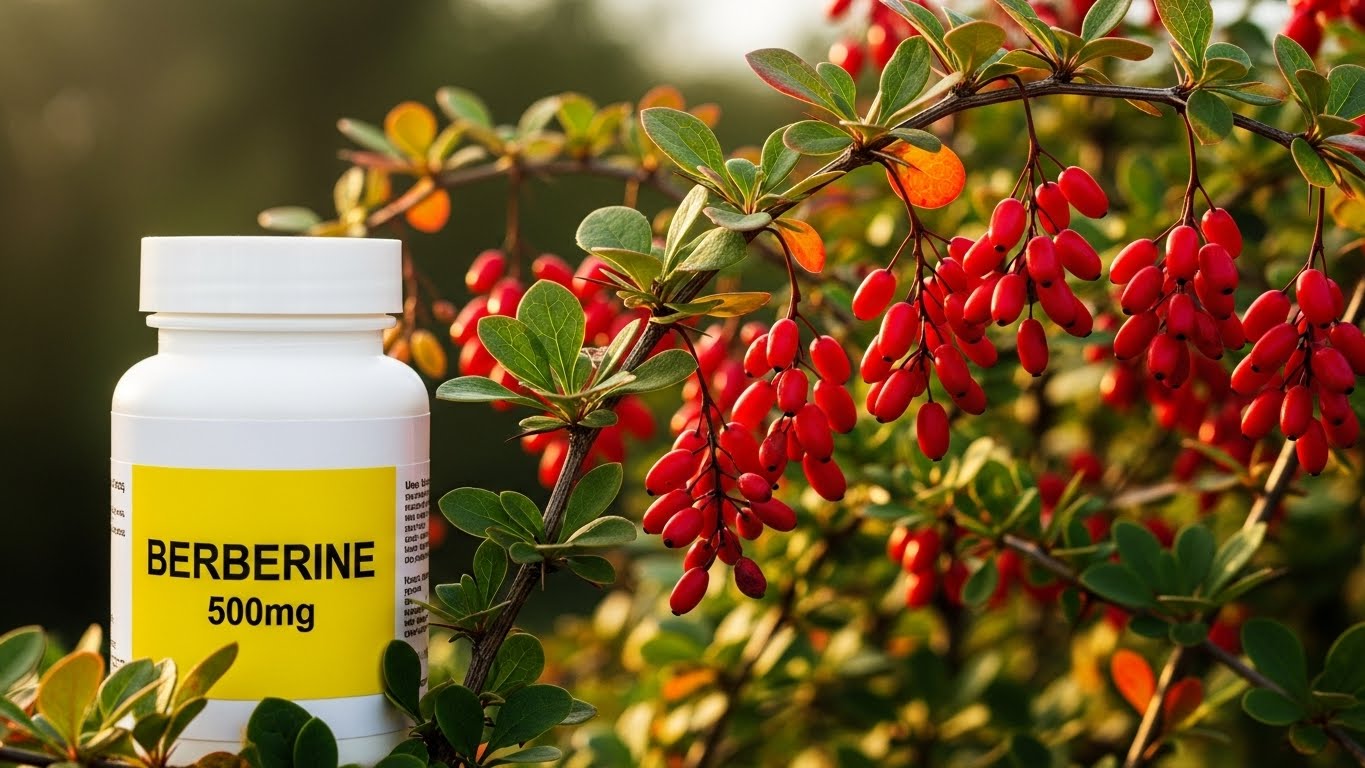
Berberine is a natural compound that comes from several medicinal plants, including barberry, goldenseal, Oregon grape, and Coptis. It has been used for centuries in traditional Chinese and Ayurvedic medicine. Research on berberine shows that it exerts metabolic effects by activating a key cellular enzyme AMP activated protein kinase (AMPK), and modulating LDL receptor expression. Berberine supplementation influences insulin signaling, and reshapes gut microbes, in part through antimicrobial actions that favor beneficial gut microbes and increased production of beneficial short chain fatty acids such as butyrate. Because berberine is poorly absorbed in the gut, majority of its activity appears to be in the intestinal lumen and mucosa, that leads to downstream effects on glucose and lipid metabolism, bile acid signaling, and inflammatory tone.
Clinical Evidence
Most of the clinical evidence for berberine’s efficacy is in the control of type 2 diabetes and lowering of cholesterol and lipids. Several clinical trials and meta analyses found that berberine reduces blood sugar levels, in the 0.5–1% range of HbA1c value. These studies also found reduction in triglycerides, total cholesterol, and LDL (bad) cholesterol, and a small increase in HDL (good) cholesterol. Pilot and phase 2 studies, including trials of berberine or berberine–ursodeoxycholate conjugates, also report improvements in insulin resistance, liver fat content in non-alcoholic fatty liver disease, and modest reduction in weight and waist size. One caveat here is that these studies had fairly small sample sizes
Safety
Berberine appears to be well tolerated upto 6 months of daily intake at commonly used oral doses and durations up to about 6 months, berberine appears generally well tolerated. Some reported side effects were gastrointestinal discomfort including diarrhea, constipation, abdominal discomfort, gas, and nausea. Important safety considerations include potential drug–drug interactions, especially additional blood glucose and blood pressure lowering when taking other medications, and possible increase in bleeding risk with anticoagulants or antiplatelets. While this is not a complete list, some reported interactions include cyclosporine, metformin, losartan, dextromethorphan, some antihypertensives and antidiabetics.
Supplementation
Typical berberine dose is between 900–1,500 mg per day in divided doses, commonly 500 mg two or three times daily with or shortly before meals. Some guidelines recommend starting at 500 mg once daily and slowly titrating up to reduce the chance of stomach distress, with limited data to support use beyond 1500mg/day or for long term continuous supplementation. Some guidelines also suggest cycling (e.g., 8–12 weeks on, then a break), although there is no actual data to suggest this is safer.
Zhang, L., Wu, X., Yang, R., Chen, F., Liao, Y., Zhu, Z., Wu, Z., Sun, J., & Wang, L. (2021, February 19). Effects of Berberine on the Gastrointestinal Microbiota. Frontiers in Cellular and Infection Microbiology. https://pmc.ncbi.nlm.nih.gov/articles/PMC7933196/
Wang, H., Zhang, H., Gao, Z., Zhang, Q., & Gu, C. (2022). The mechanism of berberine alleviating metabolic disorder based on gut microbiome. Frontiers in Cellular and Infection Microbiology. https://www.frontiersin.org/journals/cellular-and-infection-microbiology/articles/10.3389/fcimb.2022.854885/full
Lee, Y. S., Kim, W. S., Kim, K. H., Yoon, M. J., Cho, H. J., Shen, Y., Ye, J.-M., Lee, C. H., Oh, W. K., Kim, C. T., Hohnen-Behrens, C., Gosby, A., Kraegen, E. W., James, D. E., & Kim, J. B. (2006, August). Berberine, a natural plant product, activates AMP-activated protein kinase with beneficial metabolic effects in diabetic and insulin-resistant states. Diabetes. https://doi.org/10.2337/db06-0006
Cheng, H., Liu, J., Tan, Y., Feng, W., & Peng, C. (2022, August). Interactions between gut microbiota and berberine, a necessary procedure to understand the mechanisms of berberine. Journal of Pharmaceutical Analysis. https://doi.org/10.1016/j.jpha.2021.10.003
Wang, Y., Shou, J.-W., Li, X.-Y., Zhao, Z.-X., Fu, J., He, C.-Y., Feng, R., Ma, C., Wen, B.-Y., Guo, F., Yang, X.-Y., Han, Y.-X., Wang, L.-L., Tong, Q., You, X.-F., Lin, Y., Kong, W.-J., Si, S.-Y., & Jiang, J.-D. (2017, May). Berberine-induced bioactive metabolites of the gut microbiota improve energy metabolism. Metabolism. https://doi.org/10.1016/j.metabol.2017.02.003
Yin, J., Ye, J., & Jia, W. (2012, August). Effects and mechanisms of berberine in diabetes treatment. Acta Pharmaceutica Sinica B. https://doi.org/10.1016/j.apsb.2012.06.003
Zhang, X., Zhao, Y., Zhang, M., Pang, X., Xu, J., Kang, C., … et al. (2012). Structural changes of gut microbiota during berberine-mediated prevention of obesity and insulin resistance in high-fat diet-fed rats. PLoS ONE. https://journals.plos.org/plosone/article?id=10.1371%2Fjournal.pone.0042529
Yin, J., Xing, H., & Ye, J. (2008, May). Efficacy of berberine in patients with type 2 diabetes. Metabolism. https://doi.org/10.1016/j.metabol.2008.01.013
Harrison, S.A., Gunn, N., Neff, G.W. et al. A phase 2, proof of concept, randomised controlled trial of berberine ursodeoxycholate in patients with presumed non-alcoholic steatohepatitis and type 2 diabetes. Nat Commun 12, 5503 (2021). https://doi.org/10.1038/s41467-021-25701-5
Ilyas, Z., Perna, S., Al-Thawadi, S., Alalwan, T. A., Riva, A., Petrangolini, G., Gasparri, C., Infantino, V., Peroni, G., & Rondanelli, M. (2020, July). The effect of berberine on weight loss in order to prevent obesity: A systematic review. Biomedicine & Pharmacotherapy. https://doi.org/10.1016/j.biopha.2020.110137
Fang, X., Wu, H., Wang, X., Lian, F., Li, M., Miao, R., Wei, J., & Tian, J. (2022, June 3). Modulation of gut microbiota and metabolites by berberine in treating mice with disturbances in glucose and lipid metabolism. Frontiers in Pharmacology. https://doi.org/10.3389/fphar.2022.870407
Berberine. WebMD. https://www.webmd.com/vitamins/ai/ingredientmono-1126/berberine
Berberine. Cleveland Clinic Health Essentials. https://health.clevelandclinic.org/berberine
What is berberine? Mayo Clinic. https://store.mayoclinic.com/education/what-is-berberine/
Yang, F., et al. (2023). Berberine influences multiple diseases by modifying gut microbiota, microbiota-associated bile acid metabolism, and blood bile acid composition. Frontiers in Nutrition. https://www.frontiersin.org/journals/nutrition/articles/10.3389/fnut.2023.1187718/full
Zhang, E., (2022) Berberine Derivatives as Novel Antidiabetes Compounds. Diabetes. https://diabetesjournals.org/diabetes/article/71/Supplement_1/1297-P/146515/1297-P-Berberine-Derivatives-as-Novel-Antidiabetes
Efficacy and Safety of Berberine in the Treatment of Diabetes with Dyslipidemia (Clinical Trial NCT00462046). ClinicalTrials.gov. https://clinicaltrials.gov/study/NCT00462046
Mathioudakis, N. (2025). A Berberine Derivative for Treatment of Type 2 Diabetes. JAMA Network Open. https://jamanetwork.com/journals/jamanetworkopen/fullarticle/2830825