
Highlights
- Fisetin is a flavonol compound found in many fruits and vegetables being investigated for its senolytic activity.
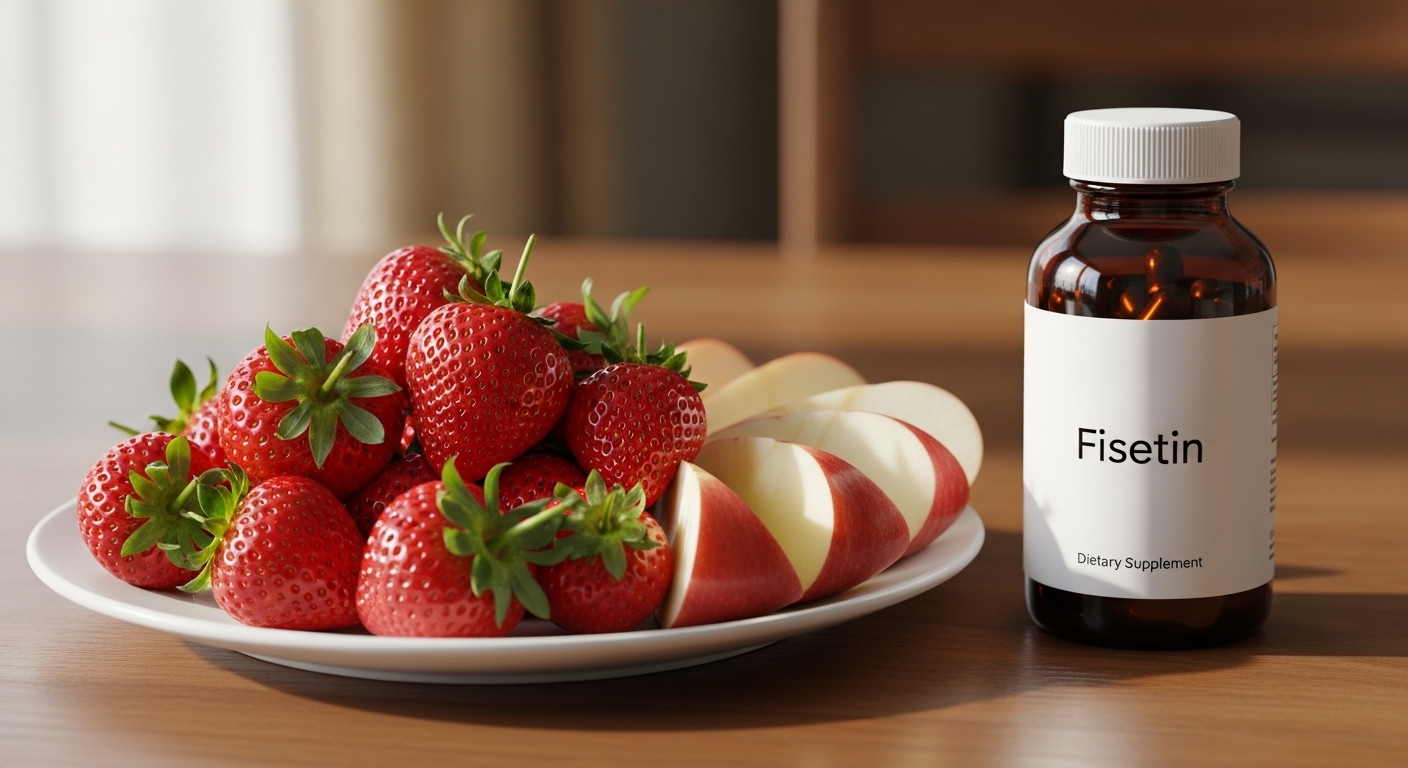
- Strawberries are the richest dietary source of Fisetin. Also contained in apples, persimmons, onions and cucumbers.
- In aged mice, intermittent treatment with oral fisetin reduced frailty, preserved grip strength.
- Fisetin improved bone health in mice with accelerated aging, reduced renal tubular senescent cell burden in the kidneys, and shows vascular and metabolic improvements.
- In human clinical trials, short‑course high‑dose regimens (‘senolytic pulses’) are being tested (e.g., 20 mg/kg/day for 2–5 days). Results are not yet known.
The Biology
Fisetin (3,3′,4′,7‑tetrahydroxyflavone) is a flavonol compound present in high level in strawberries (160 ug/g) and also in fruits and vegetables such as apples (27 ug/g), persimmons, onions and cucumbers. It is a relatively hydrophobic molecule that can easily cross cell membranes. In mammalian systems, it exhibits antioxidant activity via direct radical scavenging and modulation of endogenous antioxidant defenses and has been shown to inhibit pro‑inflammatory signaling pathways such as NF‑κB.
While Fisetin has significant antioxidant effects, it is most notable for its senolytic effects in in vitro and in vivo. It reduces survival pathways (e.g., BCL 2 family), inhibits the mTOR growth pathway, and promote apoptosis selectively in senescent cells.
A widely acclaimed study tested ten different plant flavonoids for their senolytic properties and found Fisetin to be the most potent in vitro. Researchers next tested fisetin in old mice by giving them high dose (100mg/kg) fisetin for 5 days. Fisetin treatment reduced expression of senescence markers (e.g., p16, and p21) [https://www.thelancet.com/journals/ebiom/article/PIIS2352-3964(18)30373-6/fulltext]], lowers markers associated with senescence associated secretory phenotype (SASP). Notably, fisetin treatment in aged mice increased both median and maximal lifespan as well as improved signs of aging in a wide range of organs. Interestingly, when fat tissue collected from human subjects was treated with fisetin, it also showed reduced senescence.
Another study old mice that ran for 8 weeks, gave two 7-day doses of fisetin (100mg/kg/day) on weeks 2 and 5 found that at the end of the 8-week period, the treated mice had better grip strength, higher skeletal muscle mass and lower senescence.
Clinical Evidence
While multiple clinical trials have been run, the results have not yet been published.
Pilot trial in healthy volunteers and older patients:
- In a trial that has not been initiated as of Feb 2026, with an open label arm in healthy volunteers (n=20) and a triple‑blind, randomized, placebo‑controlled arm in older subjects (n=40) 20mg/kg/day of fisetin or placebo was given for 2 days followed by a 3-month follow-up. Aside from safety, the goal was to assess chronic inflammation, senescent cell markers, and general health. Results are not yet known.
Blood vessel function in older subjects:
- In an ongoing trial, older subjects received 20mg/kg/day of fisetin for 5-days. Aside from safety and tolerability, vascular function is scheduled to be tested.
While as of Feb 2026 as many as 34 studies list Fisetin as an intervention, no clinical trial data is currently available.
Safety
Fisetin inhibits the liver cytochrome P450 (CYP450) enzymes CYP2C8 and CYP2C9. CYP450 enzymes are responsible for metabolizing drugs. This may have an effect on other drugs a person is taking at the same time as fisetin. In a clinical trial of patients with Gulf War Illness, 800mg/day of fisetin given for 30 days, there were self-reported incidence of upset stomach, migraine, headaches, GERD, headaches, and nausea. While only one out of 11 subjects reported having each of the adverse events, and two out of 11 had worsening fatigue, the small sample size cannot rule out a treatment-mediated effect.
In a phase I bioavailability and pharmacokinetics study two cases of decreased appetite and bloating was reported.
Supplementation
All current use of Fisetin is as a dietary supplement, and there are no formal guidelines available for supplementation. Based on available clinical trial planning data, Fisetin has been tested in human subjects at 20mg/kg/day for 2 to 5 days of ‘pulse dosing’ followed by a long period of observation. This is 1.4 g/day for a 70kg adult.
Liu, X., Li, X., & Xu, G. (2024, June). Fisetin: A promising senolytic agent for aging and age-related diseases. Mechanisms of Ageing and Development. https://www.sciencedirect.com/science/article/pii/S0047637424000952
Kashyap, D., Garg, V. K., Tuli, H. S., Yerer, M. B., Sak, K., Sharma, A. K., Kumar, M., Aggarwal, V., & Sandur, S. K. (2024, February 13). Fisetin: A bioactive phytochemical with potential for cancer prevention and pharmacotherapy. Journal of Biochemical and Molecular Toxicology. https://doi.org/10.1002/jbt.21583
Khan, N., Syed, D. N., Ahmad, N., & Mukhtar, H. (2019, February 15). Fisetin: A Dietary Antioxidant for Health Promotion. Molecules. https://doi.org/10.3390/molecules24040708
Maher, P. (2014, July). Fisetin: Dietary Flavonoid for Health and Disease. Basic & Clinical Pharmacology & Toxicology. https://doi.org/10.1111/bcpt.12229
Kadakia, E., et al. (2022, February 2). Fisetin as a Senotherapeutic Agent: Biopharmaceutical Properties and Pathways for Delivery. International Journal of Molecular Sciences. https://doi.org/10.3390/ijms23031707
Khan, N., et al. (2013, September 1). Fisetin: A Dietary Antioxidant for Health Promotion. Anti-Cancer Agents in Medicinal Chemistry. https://doi.org/10.2174/18715206113139990129
Yousefzadeh, M. J., et al. (2018, October). Fisetin is a senotherapeutic that extends health and lifespan. EBioMedicine. https://www.thelancet.com/journals/ebiom/article/PIIS2352-3964(18)30373-6/fulltext
Verma, S., et al. (2024). Therapeutic potential of fisetin in various metabolic disorders. PubMed Central (PMC). https://pmc.ncbi.nlm.nih.gov/articles/PMC12341784/
Effect of Fisetin on Senescent Cell Burden and Physical Function in Older Adults (Clinical Trial NCT06431932). ClinicalTrials.gov. https://clinicaltrials.gov/study/NCT06431932
Trial of Fisetin to Alleviate Frailty in Older Adults (Clinical Trial NCT06133634). ClinicalTrials.gov. https://clinicaltrials.gov/study/NCT06133634
Shia, C. S., et al. (2018, June). Metabolism and pharmacokinetics of fisetin in rats. Drug Metabolism and Pharmacokinetics. https://doi.org/10.1016/j.dmpk.2017.12.006
Sia, C. S., et al. (2009, March). Metabolism of Fisetin and Its Interaction with Methylglyoxal. Drug Metabolism and Disposition. https://doi.org/10.1124/dmd.108.023416
Grynkiewicz, G., & Demchuk, O. M. (2021, March 2). New Perspectives for Fisetin. International Journal of Environmental Research and Public Health. https://www.mdpi.com/1660-4601/18/5/2483
Rodríguez-Rodríguez, C., et al. (2022, September 14). Fisetin: a systemic review of its sources, health benefits and molecular mechanisms. Journal of Nutritional Science. https://doi.org/10.1017/jns.2022.72